
Digital SAT Scoring
The final score of the Digital SAT is calculated by combining the scores from both primary sections:
- Reading and Writing: Scored out of 800 points
- Math: Scored out of 800 points
Total Maximum Score: 1600 points
The Digital SAT does not penalize you for incorrect answers. This means there is no negative marking — so it is always better to attempt every question, even if you’re unsure.
Digital SAT – Test Structure
Reading and Writing Section
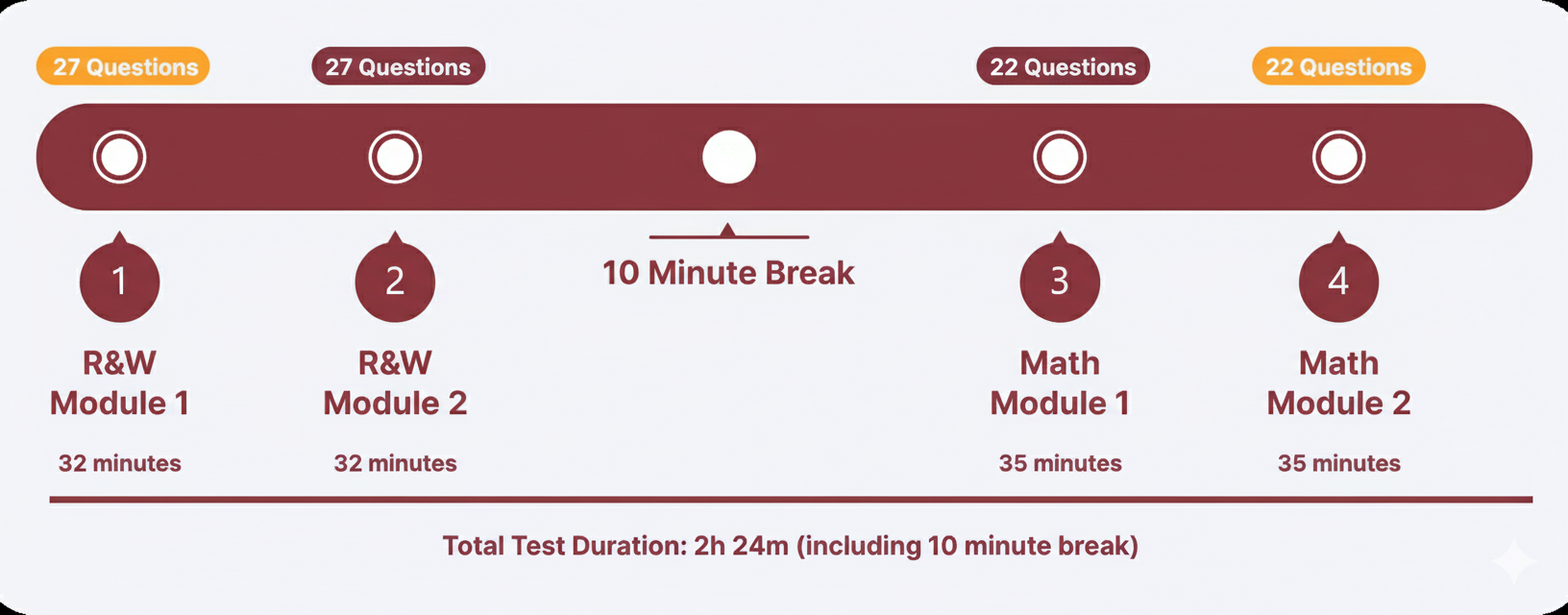
Composed of 2 modules, each containing 27 questions to be answered within 32 minutes.
- Four-option multiple-choice questions only
- 11 question types distributed across 4 content domains
- ① Words in Context
- ② Text Structure and Purpose
- ③ Cross-Text Connections
- ④ Central Ideas and Details
- ⑤ Command of Textual Evidence
- ⑥ Command of Quantitative Evidence
- ⑦ Inferences
- ⑧ Boundaries
- ⑨ Form, Structure, and Sense
- ⑩ Transitions
- ⑪ Rhetorical Synthesis
Questions on ⑤ and ⑥, and ⑧ and ⑨ can appear in alternating order. Within the same type, questions are arranged from easiest to hardest.
Math Section
Composed of 2 modules, each containing 22 questions to be answered within 35 minutes.
- Four-option multiple-choice (~75%) + Student-produced response (~25%)
- Various question types distributed across 4 content domains
- Linear equations in one variable
- Linear equations in two variables
- Linear functions
- Systems of two linear equations in two variables
- Linear inequalities in one or two variables
- Equivalent expressions
- Nonlinear equations in one variable and systems in two variables
- Nonlinear functions
- Ratios, rates, proportional relationships, and units
- Percentages
- One-variable data: distributions and measures of center/spread
- Two-variable data: models and scatterplots
- Probability and conditional probability
- Inference from sample statistics and margin of error
- Evaluating statistical claims: observational studies and experiments
- Area and volume
- Lines, angles, and triangles
- Right triangles and trigonometry
- Circles
A built-in graphing calculator is available on the entire Math section (students may also bring their own approved calculator). Questions are arranged from easiest to hardest, with types appearing randomly roughly matching the distribution.
Source: The Digital SAT Suite of Assessments Specifications Overview (College Board)
EXCELLENTTrustindex verifies that the original source of the review is Google. Joining this PTE class was one of the best decisions I made in my journey. The trainers are experienced and supportive, especially when it comes to writing, reading, listening, and speaking modules. The feedback is detailed and helps improve quickly. The study material is well-organized, and regular mock tests really boost confidence.Posted onTrustindex verifies that the original source of the review is Google. Dhaval sir is the best coach he helped me a lot in receiving good bands in the IELTS exam also. Best teacher ever met. Thank you, sirPosted onTrustindex verifies that the original source of the review is Google. Amazing guidance by sir for PTE.Posted onTrustindex verifies that the original source of the review is Google. I’m incredibly grateful to Dhaval Sir for helping me achieve my desired CELPIP score for immigration purposes! His flexible scheduling made it easy to fit lessons into my busy routine, which was a huge relief.The online lectures were extremely convenient and well-organized, allowing me to learn effectively from the comfort of my home. Dhaval Sir’s teaching style was clear, supportive, and tailored to my needs, which made a big difference in boosting my confidence and skills.I highly recommend Dhaval Sir to anyone preparing for CELPIP, his professionalism, adaptability, and engaging lessons truly set him apart. Thank you so much for your guidance and support!Posted onTrustindex verifies that the original source of the review is Google. This classes are really amazing. As sir is friendly and patient it makes experience more valuable. He never gets tired of teaching or helping as I always have questions or come up with different stuffs everyday. His politeness is the reason why I joined this classes.Posted onTrustindex verifies that the original source of the review is Google. Joining this IELTS classes is one of the best decision of my life as atmosphere is so friendly and sir is available all the time to help and teach. Sir is really a patient human and soft spoken and main highlight is that lectures never feels boring or off mood.Posted onTrustindex verifies that the original source of the review is Google. I took online class for Celpip. And I Dhawal sir is very supportive coach.I like his way of teaching. I got overall 9 score in Celpip test☺️. Thank you so much sir. 🤗Posted onTrustindex verifies that the original source of the review is Google. Great learning experience for pte examinationPosted onTrustindex verifies that the original source of the review is Google. Perfect classes to study IELTS. Every concept is taught in very good manner.